In Development: Maximo Hernandez and the Fishing Ranchos of Tampa Bay
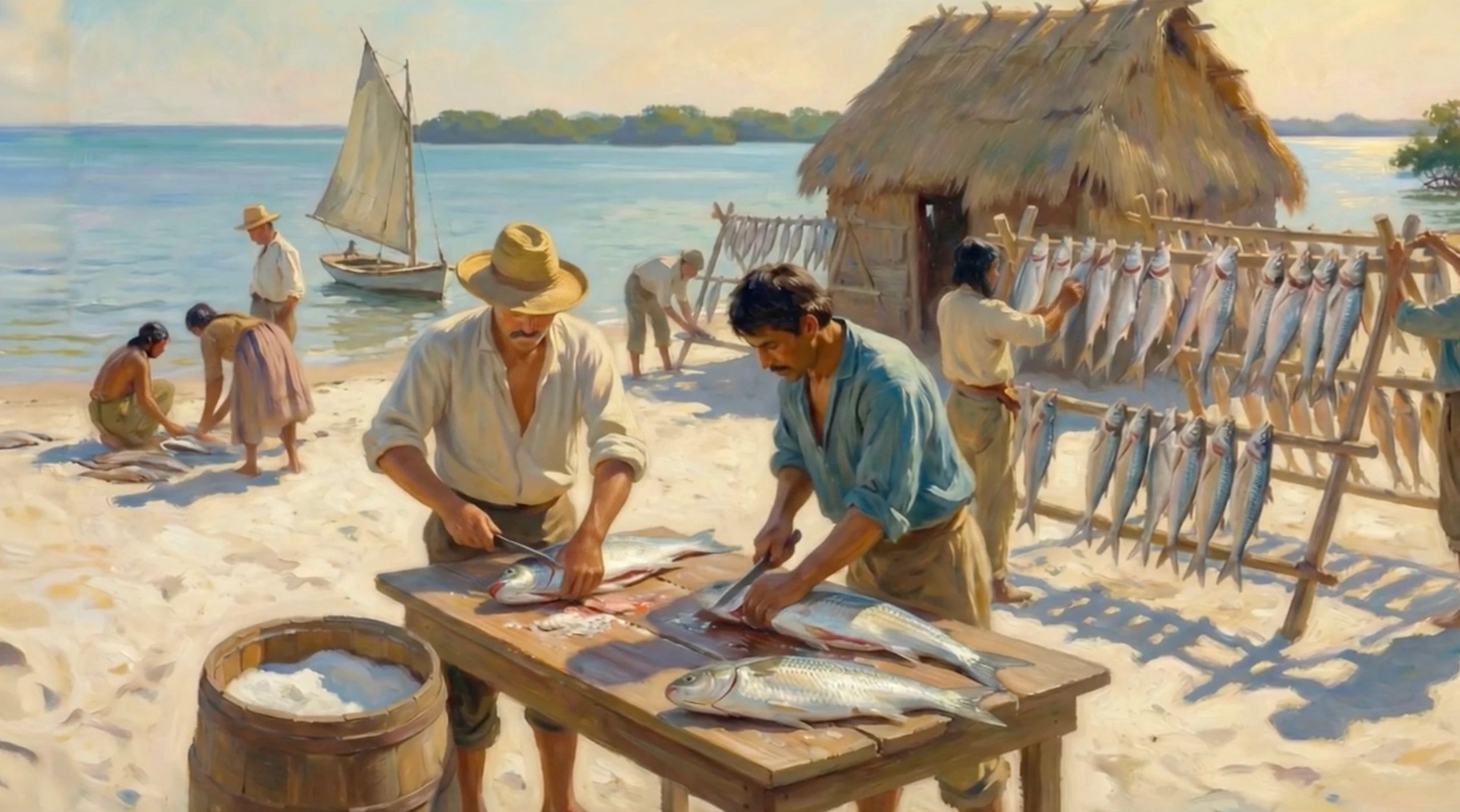
Maximo and the Fishing Ranchos of Tampa Bay will use emerging AI tools to create a short historical drama based on the life of Maximo Hernandez, a Spanish fisherman who established a fishing rancho on Tampa Bay in the 1840s. The former rancho site now includes a City of St. Petersburg park, a marina, and part of Eckerd College. The film will use extensive primary-source research and guidance from experts and descendants to develop historically accurate imagery and animation.

Public Events
The Maximo Project will culminate in a series of public events at Eckerd College in February 2027, including an exhibition of images and archaeological artifacts, a film screening and discussion with descendants, and a site visit to Maximo Park.
Maximo and the Fishing Ranchos of Tampa Bay is supported by Florida Humanities, the National Endowment for the Humanities, and the Jacarlene Foundation. Additional funding is provided from a Level Up grant from the City of St. Petersburg. The Alliance for Weedon Island Archaeological Research and Education (AWIARE) and Eckerd College are the project’s community partners.
Maximo Production Team

Polita Glynn Producer, Writer and Director
Merfolk Media Alliance, Project Director, Writer, and Creative Director
Polita Glynn is the founder and director of Merfolk Media Alliance. She is developing the Maximo story and manages all aspects of the project, including public humanities events with community partners.
Glynn specializes in filmmaking and creative storytelling focused on history, cultural diversity, and the environment. Her film projects have been funded by the State of Florida, the National Endowment for the Arts, the Sundance Institute, Florida Humanities, the St. Petersburg Arts Alliance, The City of St. Petersburg and Creative Pinellas. She also has extensive experience in non-profit and project management, community engagement, and outreach. Glynn received her B.A. in American Studies from Bennington College, an Ed.M. from the Harvard University Graduate School of Education and studied film and television production at the University of Miami School of Communication.
Devin Rice Filmmaker, Editor, and Music Composer
Devin Rice brings over 35 years of experience in the motion picture and television industry to the project. With formal training that includes an M.F.A. in Film from the Vermont College of Fine Arts, a B.A. in Theatre from Eckerd College, and a Specialist Certificate in Composition and Orchestration for Film and TV from the Berklee College of Music, Rice offers a combination of artistic versatility and professional depth. His creative toolkit spans the full spectrum of visual storytelling, including documentary filmmaking, cinematography, video editing, 3D animation, motion graphics, music composition, sound design, graphic design, and FAA-licensed drone operation. Rice teaches Documentary Production, Screenwriting, and Motion Capture as an adjunct professor at the university level. Glynn and Rice previously partnered on the projects ‘Underground History’ and ‘Brick Roads of St. Petersburg.


